When Your AI Doesn't Know What It Doesn't Know
Most AI failures in enterprise settings aren't hallucination problems - they're retrieval problems. A language model confidently answers a question using outdated policy documents, ignores the most relevant clause in a 400-page contract, or synthesises information from the wrong version of a technical standard. If your organisation is evaluating AI implementation services in Australia, this is the architectural challenge that separates a proof-of-concept from a production system that people actually trust.
Retrieval-Augmented Generation (RAG) is the engineering approach that addresses this directly. RAG is a system architecture that combines a language model with a dynamic retrieval layer, allowing the model to query a structured knowledge base at inference time rather than relying solely on its training data. The result is an AI system grounded in your documents, your data, and your current operational reality - not a statistical average of the internet.
This article covers what it takes to build RAG systems that hold up under large-scale data analysis demands: real document volumes, regulated industries, and users who need to trust the output.
Why Context Windows Are the Wrong Mental Model
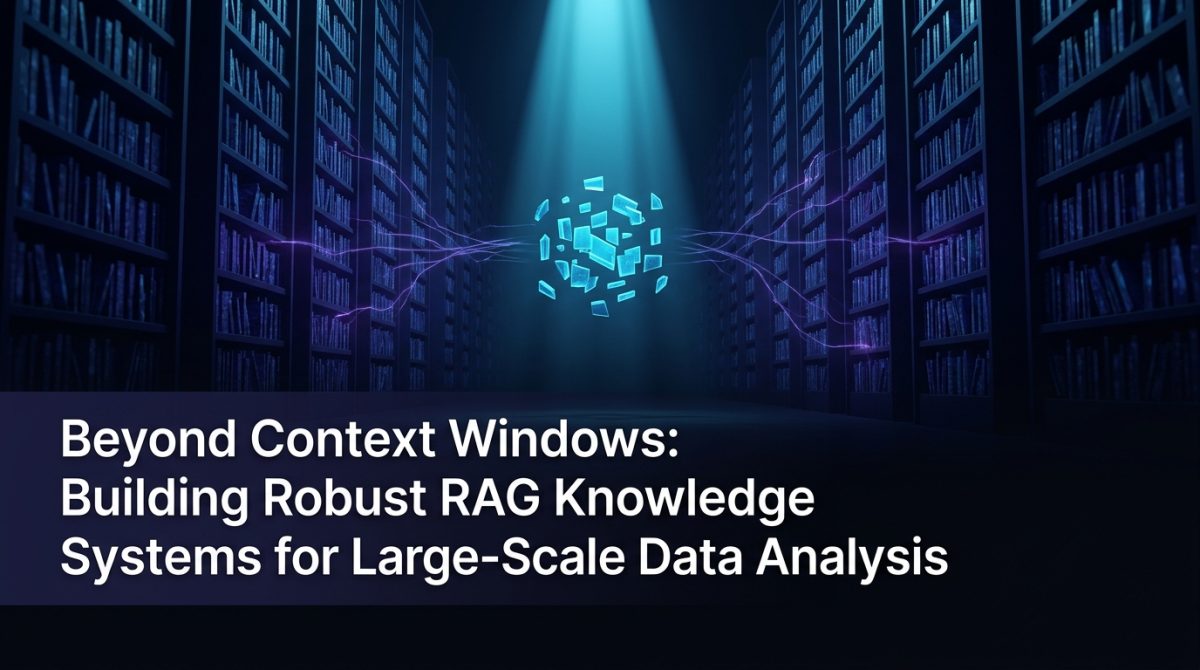
Treating RAG as a workaround for context window limitations misses the point entirely. Context windows are a constraint, but the core problem RAG solves is relevance at scale - finding the right 500 words out of 50 million.
Modern language models have expanded context windows significantly (some now accepting 128,000 tokens or more), but stuffing an entire document corpus into a prompt is neither practical nor effective. Attention mechanisms degrade over long contexts, inference costs scale with token count, and retrieval precision drops when the model must process irrelevant material alongside relevant content.
The correct mental model is information retrieval first, generation second. RAG systems that perform well in production treat the retrieval layer as a precision instrument, not a document dump.
The practical implication: your chunking strategy, embedding model selection, and index architecture matter as much as your choice of language model. A well-retrieved 300-token chunk outperforms a poorly retrieved 10,000-token context block every time.
The Four Layers of a Production RAG System
A production-grade RAG system consists of four interdependent layers, each requiring deliberate engineering decisions.
1. Document ingestion and parsing
Document parsing is where most enterprise RAG projects fail first. PDFs with scanned content, inconsistent table formatting, multi-column layouts, and embedded images all require preprocessing before they become useful retrieval targets. Tools like unstructured.io, pdfplumber, and Azure Document Intelligence handle different parsing scenarios with different accuracy profiles.
For regulated industries - legal, engineering, financial services - document parsing accuracy directly affects AI data accuracy downstream. A misread table cell in a financial statement or a dropped clause in a contract creates compounding errors through the entire retrieval chain.
2. Chunking strategy
Chunking refers to the method by which documents are split into retrievable units. Fixed-size chunking (e.g., 512 tokens with 50-token overlap) is simple but context-blind. Semantic chunking, which splits on topic boundaries rather than token counts, produces higher-quality retrieval at the cost of additional preprocessing complexity.
For technical documents, a hybrid approach works well: fixed chunking for dense reference material, semantic chunking for narrative or procedural content.
3. Embedding and vector indexing
Embeddings convert text chunks into numerical vectors that encode semantic meaning. Vector similarity search then retrieves chunks whose meaning is closest to the user's query. The choice of embedding model significantly affects retrieval quality - domain-specific fine-tuned embeddings outperform general-purpose models on specialised corpora by 15-30% on standard retrieval benchmarks.
4. Retrieval and reranking
Retrieval returns candidate chunks; reranking refines the selection. A cross-encoder reranker evaluates query-chunk pairs directly, producing more accurate relevance scores than vector similarity alone. Adding a reranking step typically improves answer accuracy by 10-20% on complex multi-document queries.
Choosing a Vector Database: Australian Data Sovereignty Considerations
The vector database you select determines your retrieval performance ceiling, your operational overhead, and - critically for Australian enterprises in regulated sectors - your data residency posture.
| Database | Hosting Options | Australian Region Support | Managed Service | Best For |
|---|---|---|---|---|
| Pinecone | Cloud only | No AU region (US/EU/Asia) | Yes | Rapid prototyping |
| Weaviate | Self-hosted or cloud | Self-hosted on AWS ap-southeast-2 | Partial | Hybrid deployments |
| Qdrant | Self-hosted or cloud | Self-hosted on any AU infrastructure | Partial | On-premises regulated data |
| pgvector | Self-hosted (PostgreSQL) | Any AU hosting provider | Via RDS (ap-southeast-2) | Existing Postgres environments |
| Azure AI Search | Managed cloud | Australia East / Southeast | Yes | Microsoft 365 integrated stacks |
| OpenSearch | Self-hosted or AWS | AWS ap-southeast-2 | Yes | Existing OpenSearch/ES workloads |
For organisations subject to Australian Privacy Act obligations, the Privacy and Other Legislation Amendment Act 2024, or sector-specific frameworks like APRA CPS 234, data sovereignty is not optional. Qdrant, pgvector, and self-hosted Weaviate deployments on Australian AWS or Azure regions (Australia East, ap-southeast-2) provide the most direct path to compliant vector storage without sacrificing retrieval performance.
Azure AI Search is worth specific mention for organisations already operating in Microsoft 365 environments - it supports Australian region deployment, integrates natively with SharePoint and Teams document libraries, and reduces the ingestion pipeline complexity considerably.
AI Implementation Services in Australia: A Real-World RAG Scenario
The following scenario is drawn from an engagement with a client in the infrastructure sector. Details have been anonymised.
An infrastructure engineering firm maintained approximately 14,000 technical documents across project archives, Australian and international standards, internal design guides, and supplier specifications. Engineers spent an estimated 3-4 hours per week searching for relevant precedents and compliance references - a conservative estimate that extrapolated to roughly 2,000 hours annually across a 10-person team.
The RAG architecture deployed used the following stack:
Ingestion:     unstructured.io + custom table extraction
Chunking:      Semantic chunking with 256-token target, 32-token overlap
Embeddings:    text-embedding-3-large (OpenAI) with domain fine-tuning
Vector store:  Qdrant (self-hosted, AWS ap-southeast-2)
Reranker:      Cohere Rerank v3
LLM:           GPT-4o via Azure OpenAI (Australia East)
After deployment, document retrieval time dropped from minutes of manual search to under 4 seconds per query. Answer accuracy on internal benchmark queries (validated against known correct answers by senior engineers) reached 91% on first retrieval. The firm estimated a reduction in standards-compliance research time of approximately 60%, with the system handling around 200 queries per day within three months of launch.
This is the operational reality of well-scoped AI implementation services in Australia - measurable time savings, verifiable accuracy, and infrastructure that meets data residency requirements.
How to Evaluate RAG System Quality Before You Go Live
Deploying a RAG system without structured evaluation is how organisations end up with AI tools their staff stop using within six weeks. Follow these steps before moving any RAG system into production.
-
Build a ground-truth evaluation set. Compile 50-100 representative queries with known correct answers drawn from your actual document corpus. This set becomes your benchmark for comparing retrieval configurations.
-
Measure retrieval recall separately from answer quality. A system can retrieve the right documents but generate a poor answer, or generate a fluent answer from the wrong documents. Track both metrics independently. Target retrieval recall above 85% on your evaluation set before optimising the generation layer.
-
Test on adversarial queries. Include queries where the correct answer is "this information is not in the knowledge base." A well-built RAG system declines to answer when retrieval confidence is low. A poorly built one hallucinates confidently.
-
Audit chunk boundary failures. Review cases where the correct answer spans a chunk boundary - these are systematic failures in your chunking strategy, not random errors. Adjust overlap size or switch to semantic chunking for the affected document types.
-
Load test your retrieval pipeline. At 50 concurrent users, many vector database configurations that perform well in development begin to show latency degradation. Test at realistic concurrency before committing to a production architecture.
-
Establish a document freshness protocol. Define how new documents enter the index, how updated documents replace stale artefacts, and how deletions propagate. A RAG system without a freshness protocol degrades silently as the knowledge base drifts from operational reality.
Frequently Asked Questions
Q: What is RAG and how does it improve AI data accuracy?
RAG (Retrieval-Augmented Generation) is an AI system architecture that retrieves relevant content from a structured knowledge base before generating a response, rather than relying solely on a model's training data. This approach directly improves AI data accuracy because the model's answers are grounded in specific, retrievable source documents - reducing hallucination and ensuring responses reflect current, organisation-specific information.
Q: How many documents can a production RAG system handle?
A well-architected production RAG system handles millions of documents without degradation in retrieval quality, provided the vector index is appropriately configured. Qdrant and pgvector deployments have been benchmarked at 100M+ vectors with sub-100ms retrieval latency on adequately provisioned hardware. However, hardware and indexing configuration costs scale materially with document volume - organisations evaluating build-versus-buy should factor in GPU-accelerated indexing for corpora above 500,000 documents, ongoing storage costs for vector indices (typically 4-10x the size of the raw text), and re-indexing overhead when embedding models are updated. For MSP operators and hosting companies, these infrastructure costs are often the primary variable in total cost of ownership.
Q: What document types does enterprise RAG support?
Enterprise RAG systems support PDFs, Word documents, Excel spreadsheets, PowerPoint presentations, HTML, plain text, and increasingly, scanned documents via OCR preprocessing. Structured data sources - SQL databases, SharePoint lists, JSON APIs - can also be integrated through custom ingestion pipelines. Document parsing quality varies significantly by file type; PDFs with complex layouts and scanned images require the most preprocessing effort.
Q: How long does it take to deploy a RAG system for an Australian enterprise?
A focused RAG deployment on a well-defined document corpus typically takes 6-12 weeks from scoping to production, depending on document volume, parsing complexity, and integration requirements. Organisations with existing Azure or AWS infrastructure in Australian regions move faster due to reduced data residency configuration overhead. Engagements that include custom embedding fine-tuning or complex multi-source ingestion pipelines typically sit at the longer end of that range.
What to Do Next
If your organisation is managing large document volumes and your staff are spending material time searching for information, a RAG architecture review is a concrete next step - not a vague strategic conversation.
Book a RAG architecture review with Exponential Tech. We'll assess your document corpus, data residency requirements, existing infrastructure, and retrieval use cases, then provide a scoped technical recommendation with realistic cost and timeline estimates.
Organisations already thinking about the broader AI investment picture can use our AI ROI calculator to quantify the productivity case before committing to a build.
The infrastructure decisions you make now - vector database selection, embedding strategy, data sovereignty posture - directly determine what your RAG system can do in 12 months. Getting the architecture right at the start is significantly cheaper than re-engineering it under production load.