The Real Cost of Sending Your Business Data to the Cloud
Most Australian businesses automating their workflows are doing it the same way: routing sensitive data through US-based cloud APIs, paying per-token fees that compound unpredictably, and accepting that their internal documents, customer records, and operational data sit on someone else's infrastructure. For many use cases, that trade-off is acceptable. For healthcare providers, legal firms, financial services companies, and government-adjacent organisations, it is not.
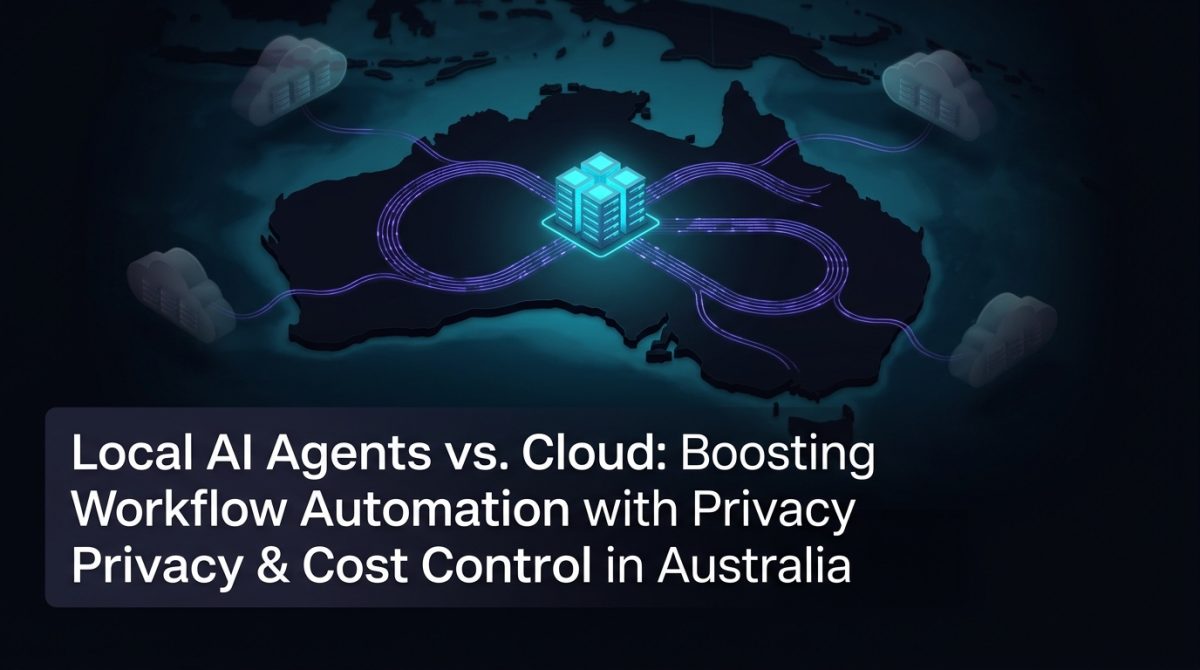
This is where ai workflow automation australia takes a different shape than the global conversation suggests. Local AI deployment - running open-source models on your own hardware or private cloud - gives Australian organisations a practical path to agentic automation without surrendering data sovereignty or budget control. This article breaks down how that works in practice, where it makes sense, and how to implement it.
What Local AI Agents Actually Are
Local AI agents are autonomous software processes that run AI inference on infrastructure you control, rather than sending requests to a third-party API. A local AI agent can read files, call internal APIs, execute code, query databases, and make sequential decisions - all without any data leaving your network perimeter.
The key distinction from traditional automation tools is agency: these systems do not just execute fixed rules. They interpret context, select tools, and adapt their behaviour based on intermediate results. A local agent handling invoice processing, for example, does not follow a rigid flowchart - it reads the document, identifies anomalies, routes exceptions to a human, and logs its reasoning, all without a predefined script for every scenario.
Modern open-source models - including Mistral 7B, LLaMA 3, and Phi-3 - run efficiently on mid-range hardware. A single NVIDIA RTX 4090 GPU handles 7B parameter models at production-grade throughput for most business automation tasks. Larger models (13B-70B parameters) run on multi-GPU workstations or private cloud instances with A100 or H100 cards.
Why Data Privacy Is a Structural Requirement, Not a Preference
Australian organisations handling personal information are bound by the Privacy Act 1988 and the Australian Privacy Principles (APPs). Sending identifiable customer data to a US-based LLM API creates cross-border disclosure obligations under APP 8. Depending on the data type and industry, this is not a grey area - it is a compliance requirement with real enforcement risk.
Healthcare providers under the My Health Records Act and financial services firms under APRA CPS 234 face additional constraints. Legal firms operating under professional secrecy obligations cannot route client matter details through shared cloud infrastructure.
Local AI deployment eliminates this problem structurally. Data processed on-premises or within an Australian-region private cloud never crosses a jurisdictional boundary. There is no API agreement to review, no data processing addendum to negotiate, and no dependency on a vendor's privacy policy staying consistent.
The practical implication: organisations in regulated industries should treat local AI not as a cost-cutting measure but as the default architecture for any AI workflow automation in Australia that touches protected data categories.
The Cost Arithmetic of Local vs. Cloud AI
Cloud AI costs are variable and scale with usage. Local AI costs are fixed and scale with capability. Understanding which model fits your workload determines which approach saves money.
Cloud AI cost structure:
- GPT-4o: approximately USD $5 per million input tokens, $15 per million output tokens
- Claude 3.5 Sonnet: approximately USD $3 per million input tokens, $15 per million output tokens
- Costs multiply with agentic workflows - a single agent task may consume 10,000-50,000 tokens across multiple reasoning steps
Local AI cost structure:
- Hardware: AUD $8,000-$25,000 for a capable workstation (one-time)
- Power: approximately AUD $150-$400/month for continuous operation
- Maintenance: minimal for stable deployments
Break-even analysis: An organisation running 500,000 agent tasks per month at an average of 20,000 tokens per task generates 10 billion tokens monthly. At GPT-4o pricing, that is roughly AUD $120,000/month. A local deployment running Mistral 7B on a $20,000 workstation breaks even in under three weeks of operation.
For lower-volume use cases - under 50,000 tasks per month - cloud APIs remain cost-competitive. The decision is not ideological; it is arithmetic.
How to Deploy a Local AI Agent Workflow: A Practical Setup
Deploying a local AI agent workflow follows a repeatable pattern regardless of the specific use case. Here is a concrete implementation path for a document processing automation, which is one of the most common starting points for Australian businesses.
Scenario: A Brisbane-based legal firm wants to automate the extraction and classification of key clauses from incoming contracts, flagging non-standard terms for solicitor review - without sending client documents to any external service.
Step 1: Select and deploy the base model
Run Ollama on a local Linux server to serve a quantised LLaMA 3 8B model. Ollama provides an OpenAI-compatible API endpoint on localhost:11434, which means existing integrations built for cloud APIs work without modification.
ollama pull llama3
ollama serve
Step 2: Build the agent orchestration layer Use LangChain or LlamaIndex to define agent tools - in this case, a PDF parser, a clause extractor, and a classification function. The agent receives a document path, extracts text, and iteratively identifies clause types against a predefined taxonomy.
Step 3: Connect to your internal systems Wire the agent output to your practice management system via its REST API. Flagged clauses write directly to the matter file. No manual copy-paste, no external SaaS middleman.
Step 4: Add a human-in-the-loop checkpoint Configure the agent to pause and send a Slack or email notification when confidence scores fall below a defined threshold (e.g., below 0.75). This keeps a solicitor in the decision loop for genuinely ambiguous cases.
Step 5: Log and audit everything Write all agent reasoning traces to a local database. For regulated industries, this audit trail is not optional - it demonstrates that decisions were made within a controlled, reviewable process.
Step 6: Iterate on prompts and tooling Run the system against a test set of 50 historical contracts before going live. Measure precision and recall on clause identification. Adjust system prompts based on failure modes, not assumptions.
This pattern - local model, agent orchestration, internal API integration, human checkpoint, audit logging - is the foundation of robust AI workflow automation for privacy-sensitive environments.
Open-Source Models Worth Using in Production Today
Open-source AI is not a compromise on quality. Several models now match or exceed GPT-3.5-class performance on structured business tasks, and some approach GPT-4-class performance on specific domains.
For general document and text tasks:
- Mistral 7B Instruct - fast, efficient, strong instruction-following at 7B parameters
- LLaMA 3 8B / 70B - Meta's current generation, strong reasoning and code capability
- Phi-3 Medium - Microsoft's 14B model, punches above its weight on structured reasoning
For code generation and technical automation:
- DeepSeek Coder V2 - competitive with GPT-4 on code tasks, runs locally
- CodeLlama 34B - reliable for Python, SQL, and shell scripting automation
For embedding and retrieval (RAG pipelines):
- nomic-embed-text - fast, accurate, runs via Ollama
- mxbai-embed-large - strong performance on Australian English business documents
All of these models are available under licences that permit commercial use. None require sending data off-premises.
What to Do Next
If your organisation is evaluating AI workflow automation in Australia and data sovereignty is a constraint, the practical starting point is an honest audit of your current data flows. Identify which automation tasks touch protected data categories, estimate your monthly token volume, and map that against the break-even arithmetic above.
From there, a proof-of-concept deployment - one local model, one agent workflow, one internal integration - takes two to four weeks to build and validate. That is enough to generate real performance data before committing to infrastructure investment.
Exponential Tech builds and deploys these systems for Australian organisations. If you want a structured assessment of where local AI fits your specific workflow requirements, our AI automation pipelines service is the right starting point. For organisations that need to think through the broader strategic picture before committing to implementation, our AI strategy and governance consulting provides the framework to make those decisions with confidence.
Frequently Asked Questions
Q: What is local AI, and how does it differ from cloud AI?
Local AI refers to running artificial intelligence models on infrastructure that you own or exclusively control, rather than sending data to a third-party cloud provider. The practical difference is that data never leaves your network, costs are fixed rather than usage-based, and you retain full control over model versions, access logs, and processing behaviour.
Q: Is open-source AI suitable for production business workflows in Australia?
Open-source AI models including LLaMA 3, Mistral, and Phi-3 are production-ready for the majority of business automation tasks including document processing, classification, summarisation, and structured data extraction. These models run on commercially available hardware, carry licences that permit business use, and perform comparably to GPT-3.5-class cloud models on most structured tasks.
Q: When does local AI make financial sense compared to cloud APIs?
Local AI deployment becomes cost-effective at approximately 50,000-100,000 agent tasks per month, depending on average token consumption per task. Below that threshold, cloud APIs typically offer lower total cost of ownership. Above it, a one-time hardware investment of AUD $15,000-$25,000 typically recovers its cost within one to three months of operation.
Q: Does running AI locally satisfy Australian Privacy Principles compliance requirements?
Running AI inference on local infrastructure eliminates the cross-border disclosure issue created by sending data to overseas API providers, which directly addresses APP 8 obligations. However, local deployment does not automatically satisfy all privacy obligations - data minimisation, access controls, and retention policies still apply and must be implemented as part of the overall system design.