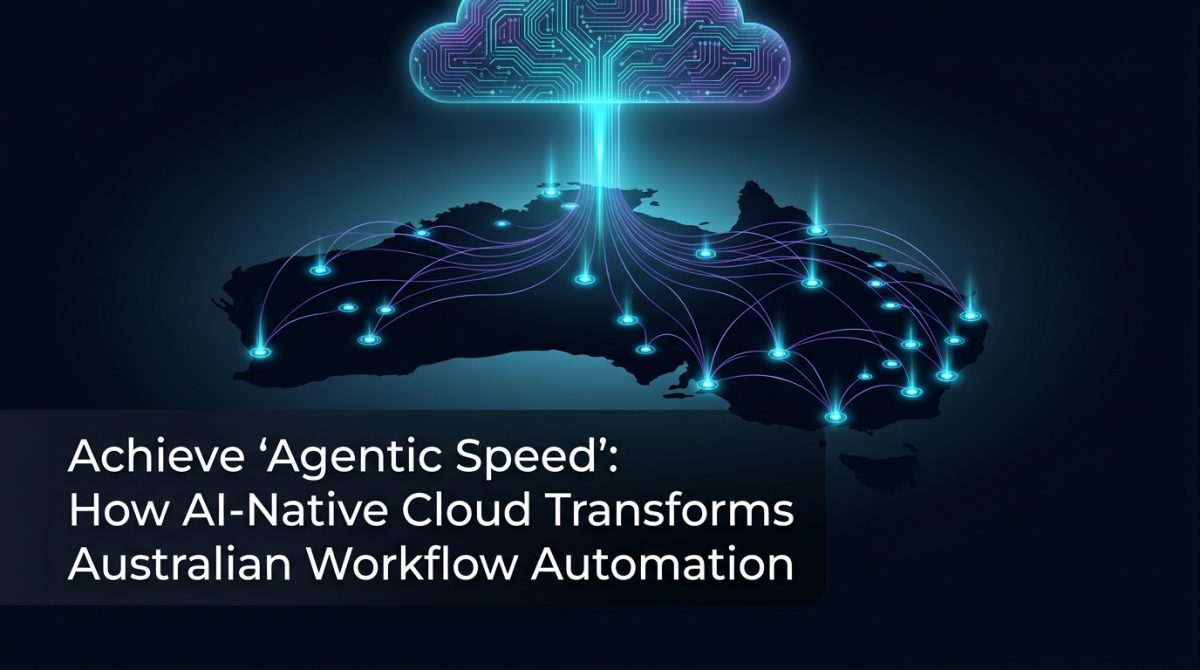
The Bottleneck Isn't Your Team - It's Your Infrastructure
Most Australian businesses attempting AI workflow automation in Australia hit the same wall: their cloud infrastructure was built for humans operating at human speed. Approval queues, sequential processing, manually triggered pipelines - these patterns made sense when a person sat at each handoff point. They become critical bottlenecks the moment you deploy agents that can execute dozens of tasks per minute.
The result is a familiar failure mode. The AI pilot succeeds. The board approves expansion. Then the infrastructure collapses under load, deployment timelines blow out to months, and the business case evaporates. This isn't an AI problem - it's an architecture problem.
Solving it requires what practitioners now call an AI-native cloud: infrastructure designed from the ground up to support autonomous, event-driven, multi-agent workloads rather than retrofitted from legacy batch-processing patterns.
What AI-Native Cloud Actually Means
AI-native cloud is infrastructure architected specifically to support autonomous agent workloads - characterised by event-driven triggers, stateless microservices, sub-second orchestration, and dynamic resource scaling that responds to agent activity rather than scheduled jobs.
This is distinct from simply "running AI on cloud." Traditional cloud deployments treat AI as another application sitting on existing infrastructure. AI-native cloud inverts that relationship: the infrastructure is designed around how agents actually behave - bursty, parallel, latency-sensitive, and highly dependent on fast data access.
The core technical characteristics of an AI-native cloud environment include:
- Event-driven orchestration - workflows trigger on data state changes, not cron schedules
- Stateless compute layers - agents spin up and terminate without persistent server overhead
- Vector-optimised data stores - retrieval-augmented generation (RAG) pipelines need millisecond lookup, not seconds
- Observability by default - every agent action is logged, traced, and auditable
- Horizontal auto-scaling - compute expands within seconds of demand spikes, not minutes
Infrastructure modernisation to this pattern typically reduces agent response latency by 60-80% compared to traditional cloud configurations, and cuts idle compute costs by 35-50% through genuine serverless execution rather than always-on virtual machines.
Why Agentic Architecture Changes Deployment Economics
Agentic architecture refers to a system design where autonomous AI agents handle decision-making, task execution, and inter-system communication without requiring human intervention at each step - enabling workflows to run at machine speed rather than human speed.
The economic implications are significant and measurable. When workflows operate at agentic speed:
Processing volume increases non-linearly. A human-managed accounts payable process might handle 200 invoices per day. An agentic equivalent running on AI-native cloud infrastructure handles 200 per hour - with the same headcount redirected to exception handling and vendor relationships.
Deployment cycles compress dramatically. Traditional enterprise software deployments run 6-18 months. Agentic pipelines built on modular, containerised infrastructure deploy in 2-6 weeks. The difference is composability: agents are assembled from tested components rather than custom-built from scratch.
Error costs drop. Human-in-the-loop processes accumulate errors at handoff points. Agentic systems with proper validation layers catch data quality issues before they propagate, reducing downstream correction costs by 25-40% in document-heavy workflows.
For Australian businesses, this matters particularly in sectors with high document and compliance volume: financial services, healthcare, construction, and professional services. The ROI case for AI workflow automation in Australia is strongest precisely where regulatory requirements create the most manual processing overhead.
How to Migrate from Legacy Pipelines to AI-native infrastructure
Moving from traditional automation to AI-native cloud is a phased process. Attempting a full cutover in one step is the most common cause of failed modernisation projects.
Step 1: Audit your current workflow trigger patterns. Map every automated process and identify whether it's time-triggered (cron), event-triggered (webhook/message queue), or manually triggered (human action). Time-triggered and manual processes are your highest-priority migration targets - they represent the largest latency gaps.
Step 2: Identify stateful dependencies. List every workflow that requires a persistent server or database connection to function. These are your architectural constraints. Stateful dependencies need to be refactored into stateless patterns before agents can operate reliably at scale.
Step 3: Containerise agent logic. Package each agent's core logic into a container (Docker is standard). This makes agents portable across cloud providers and enables the horizontal scaling that AI-native infrastructure depends on. A well-containerised agent deploys in under 90 seconds.
Step 4: Implement an event bus. Replace direct API calls between systems with a message queue or event streaming platform (AWS EventBridge, Google Pub/Sub, or Azure Service Bus are common choices in Australian enterprise environments). This decouples agents from each other, preventing cascade failures.
Step 5: Add observability before go-live. Deploy distributed tracing (OpenTelemetry is the current standard) before agents handle production workloads. Without trace data, diagnosing agent failures in production is extremely difficult. Observability is not optional - it's a prerequisite for operating agentic systems responsibly.
Step 6: Run parallel for 2-4 weeks. Keep the legacy pipeline running alongside the new agentic system. Compare outputs, flag discrepancies, and build confidence before decommissioning the old process. This step alone prevents the majority of production incidents in migration projects.
A Practical Scenario: Document Processing in a Brisbane Professional Services Firm
Consider a mid-sized Brisbane accounting firm processing 1,500 client documents per month - tax returns, financial statements, engagement letters. Their existing process: documents arrive by email, a staff member downloads and renames them, uploads to a document management system, and manually triggers a review workflow. Average handling time per document: 4.5 minutes. Monthly labour cost for this task alone: approximately $8,400.
After migrating to an AI-native pipeline:
- Email attachments trigger an event the moment they arrive
- An extraction agent classifies the document type and extracts key fields using a fine-tuned document model
- A validation agent cross-checks extracted data against the client record in the practice management system
- Clean documents route automatically to the correct matter file; exceptions flag for human review
- The entire process completes in under 40 seconds per document
Outcome: 94% of documents process without human intervention. Staff handling time drops from 4.5 minutes to under 30 seconds per document (exception review only). Monthly labour cost for document intake: under $900. The infrastructure cost to run the pipeline: approximately $340/month on a serverless cloud configuration.
This is the operational reality of AI workflow automation for Australian businesses - not theoretical efficiency gains, but measurable reductions in per-unit processing cost.
Cost Savings That Survive Scrutiny
Fast deployments and agentic architecture only create durable value if the cost model holds at scale. Three cost levers determine whether AI-native cloud delivers genuine savings or simply shifts expenditure:
Compute costs. Serverless execution means you pay per invocation, not per hour of server uptime. For bursty workloads - which describes most business automation - this reduces compute spend by 40-65% compared to reserved instances sized for peak load.
Integration costs. AI-native infrastructure built on standard event buses and container orchestration (Kubernetes or managed equivalents like AWS ECS) dramatically reduces the cost of adding new data sources or downstream systems. Each new integration takes hours, not weeks of custom development.
Maintenance costs. Stateless, containerised agents are easier to update, roll back, and test than monolithic automation scripts. When a business process changes - and they always do - updating an agentic pipeline takes a fraction of the time required to modify legacy RPA or custom-coded automation.
The combination of these three levers is why infrastructure modernisation to AI-native patterns typically delivers 3-5x ROI within 18 months for organisations with sufficient workflow volume to justify the migration investment.
What to Do Next
If your organisation is experiencing the symptoms described here - slow AI deployments, infrastructure bottlenecks, or automation pilots that don't scale - the starting point is a structured workflow audit, not a technology purchase.
Map your ten highest-volume manual processes. For each one, calculate current labour cost, error rate, and average handling time. This gives you the baseline against which any automation investment must be measured. Businesses that skip this step consistently underestimate both the opportunity and the complexity of their existing workflows.
From that audit, you can build a prioritised migration roadmap: which processes to automate first, what infrastructure changes are prerequisites, and what the realistic ROI timeline looks like.
Exponential Tech works with Australian businesses to design and deploy AI workflow automation pipelines that operate at agentic speed on AI-native infrastructure - built for production, not proof-of-concept. If you want a clear-eyed assessment of where your current automation investment stands, start with a conversation.
Frequently Asked Questions
Q: What is AI-native cloud and how does it differ from standard cloud infrastructure?
AI-native cloud is infrastructure designed specifically to support autonomous agent workloads, with event-driven triggers, stateless compute, and sub-second orchestration as core design principles - not afterthoughts. Standard cloud infrastructure was built for human-operated applications and requires significant architectural changes before it can support agentic systems reliably at scale.
Q: How long does it take to deploy an AI workflow automation pipeline in Australia?
A well-scoped agentic pipeline built on AI-native infrastructure deploys in 2-6 weeks, depending on the number of systems being integrated and the complexity of the business rules involved. This assumes containerised agent components and a clear event-driven architecture - organisations starting from legacy monolithic automation take longer due to the prerequisite refactoring work.
Q: What types of Australian businesses benefit most from agentic architecture?
Businesses with high volumes of structured document processing, multi-system data synchronisation, or compliance-driven approval workflows see the strongest ROI from agentic architecture. Financial services, professional services, healthcare, and construction firms in Australia consistently meet this profile due to regulatory documentation requirements.
Q: How do I calculate the ROI of AI workflow automation for my business?
Start by calculating the current fully-loaded labour cost of the processes you intend to automate, including error correction and rework. Compare this against the combined cost of infrastructure, deployment, and ongoing maintenance for the agentic system. Most Australian businesses with more than 500 monthly process instances achieve payback within 9-14 months on a well-scoped automation project.