The Infrastructure Decision That Determines Your AI Project's Fate
Most AI projects in Australia don't fail because of bad models. They fail because of bad infrastructure decisions made before a single line of code is written. The wrong choice between hyperscaler, local deployment, or specialised cloud locks teams into cost structures, latency profiles, and data governance constraints that compound over time. If you're evaluating AI implementation services australia for your organisation, the infrastructure layer deserves as much scrutiny as the model itself.
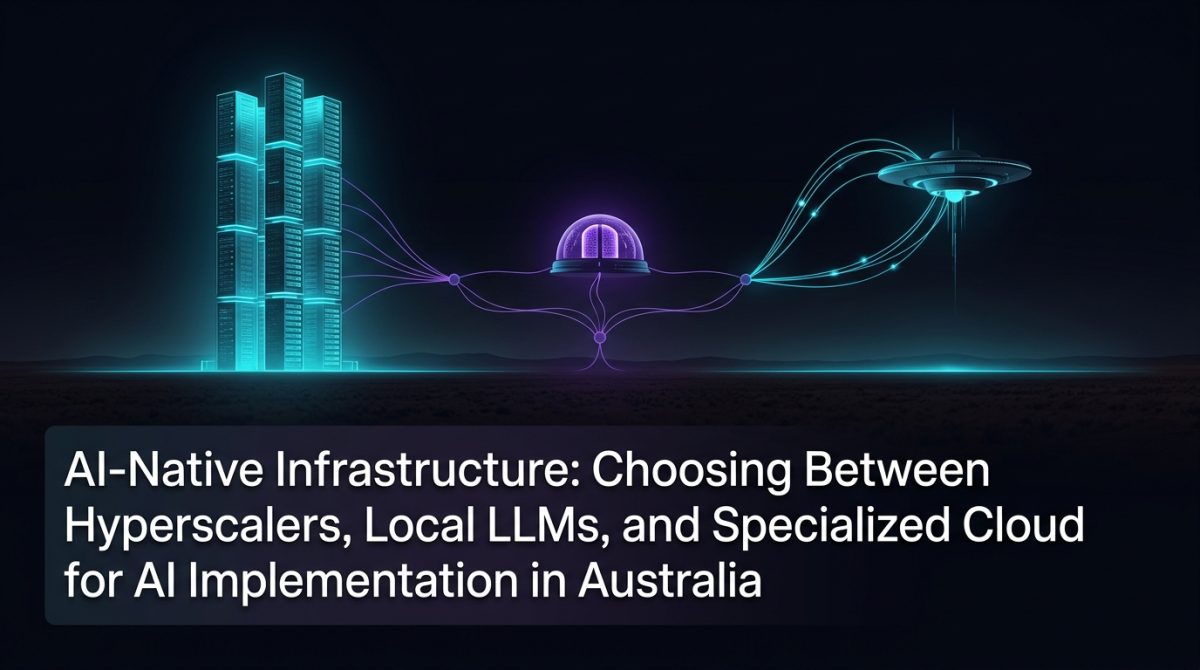
This article breaks down the three dominant infrastructure patterns - hyperscaler APIs, local LLM deployment, and specialised AI cloud - and gives you a framework for choosing between them based on your actual workload, data classification, and budget constraints.
Hyperscalers: High Capability, Real Trade-offs
Hyperscaler AI infrastructure refers to managed AI services delivered by major cloud providers - AWS (Bedrock, SageMaker), Google Cloud (Vertex AI), and Microsoft Azure (Azure OpenAI Service) - where compute, model hosting, and API access are fully abstracted from the customer.
For most Australian businesses starting out, hyperscalers are the fastest path to production. You get access to frontier models (GPT-4o, Claude 3.5 Sonnet, Gemini 1.5 Pro), managed scaling, and enterprise SLAs without provisioning a single GPU. The trade-offs are real, though:
- Data residency: As of mid-2025, Azure OpenAI Service offers Australian data residency in the Australia East region. AWS Bedrock and Google Vertex AI have Sydney-region endpoints but model availability varies by region. Always verify which models are available in-region before designing your architecture.
- Latency: API round-trips from Sydney to US-based endpoints add 150-250ms per call. For synchronous user-facing features, this is noticeable. For batch processing, it's irrelevant.
- Cost at scale: At high token volumes, hyperscaler API costs scale linearly. A document processing pipeline handling 10 million tokens per day at GPT-4o pricing costs roughly AUD $700-$900/day depending on input/output ratio. That's $250,000+ annually for a single pipeline.
- Vendor lock-in: Prompt engineering optimised for one provider's models rarely transfers cleanly to another. Abstract your LLM calls behind a provider-agnostic interface (LiteLLM or a custom wrapper) from day one.
Hyperscalers are the right choice when: you need frontier model capability, your data classification permits cloud processing, your volumes don't justify dedicated infrastructure, and you need to move fast.
Local LLM Deployment: Sovereignty and Cost Control at a Price
Local LLM deployment means running open-weight models - Llama 3, Mistral, Qwen 2.5, Phi-3 - on infrastructure you control, either on-premises or in a private cloud tenancy. This is the correct choice for any workload involving sensitive data that cannot leave your environment.
The performance gap between open-weight and frontier models has closed significantly. Llama 3.1 70B running on a well-provisioned inference server handles the majority of enterprise tasks - summarisation, classification, RAG-based Q&A, structured extraction - at quality levels that are indistinguishable from GPT-4 for most business users.
A practical deployment stack for local LLMs looks like this:
Hardware:     2x NVIDIA A100 80GB (or equivalent H100/L40S)
Serving:      vLLM or Ollama (production vs. dev)
Model:        Llama 3.1 70B or Qwen 2.5 72B (quantised to 4-bit for memory efficiency)
API layer:    OpenAI-compatible endpoint via vLLM
Monitoring:   Prometheus + Grafana for token throughput and GPU utilisation
A single A100 80GB running Llama 3.1 70B at 4-bit quantisation delivers approximately 40-60 tokens/second for single-user inference. For concurrent workloads, vLLM's continuous batching increases effective throughput by 3-5x compared to naive serving.
The real costs of local deployment:
- GPU hardware: AUD $30,000-$50,000 per A100 (or $3,000-$6,000/month cloud GPU rental)
- Engineering time to maintain the inference stack: 0.25-0.5 FTE ongoing
- Model updates are manual - you don't automatically get capability improvements
Local deployment is the right choice when: data sovereignty is non-negotiable, you have consistent high-volume workloads that make dedicated compute cost-effective, or you need sub-50ms inference latency for real-time applications.
Specialised AI Cloud: The Middle Path
Specialised AI cloud providers - Together AI, Fireworks AI, Groq, and increasingly Australian-specific options - sit between hyperscalers and local deployment. They offer hosted open-weight models on dedicated infrastructure, often at 60-80% lower cost than equivalent hyperscaler API calls, with latency that matches or exceeds hyperscalers due to purpose-built inference hardware.
Groq's LPU (Language Processing Unit) architecture, for example, delivers Llama 3.1 70B inference at 250-300 tokens/second - 5-8x faster than GPU-based serving. For applications where response speed directly affects user experience, this matters.
The trade-off is model selection. You're limited to the provider's catalogue of open-weight models. If your use case genuinely requires GPT-4o or Claude 3.5 Sonnet's specific capabilities, specialised cloud doesn't solve that.
When specialised cloud makes sense:
- You've validated that an open-weight model meets your quality bar
- Cost optimisation is a priority (AI cost optimisation is one of the highest-leverage activities in any AI programme)
- You want managed infrastructure without the overhead of running your own inference stack
- Data residency requirements can be met by the provider's available regions
How to Choose: A Decision Framework in Five Steps
The right infrastructure choice follows directly from your workload requirements. Work through these steps before committing to any architecture.
-
Classify your data. Determine whether your data is public, internal, confidential, or regulated (subject to Privacy Act, APRA CPS 234, or sector-specific requirements). Regulated data typically requires local deployment or a provider with a signed data processing agreement and Australian data residency.
-
Estimate your token volume. Calculate expected daily input + output tokens across all planned use cases. Below 5 million tokens/day, hyperscaler APIs are almost always cheaper than dedicated infrastructure. Above 20 million tokens/day, dedicated infrastructure (local or specialised cloud) usually wins on cost.
-
Define your latency requirements. Synchronous, user-facing features need sub-500ms end-to-end response times. Async batch processing has no meaningful latency constraint. This single factor often determines whether local deployment is necessary.
-
Assess your engineering capacity. Local LLM deployment requires ongoing DevOps attention. If your team lacks ML infrastructure experience, the operational overhead of self-hosted models creates more risk than it eliminates. Factor this honestly.
-
Run a 30-day cost model. Build a spreadsheet with your projected token volumes, API pricing, and infrastructure costs. Include engineering time at a realistic hourly rate. The right answer usually becomes clear within 15 minutes of honest modelling. Our team regularly works through this exercise as part of structured AI strategy consulting australia engagements.
A Scenario: Healthcare Document Processing in Queensland
A Queensland-based healthcare network needed to process 50,000 clinical documents per month - discharge summaries, referral letters, pathology reports - extracting structured data for a downstream analytics platform.
The constraints: Patient data under Queensland Health privacy requirements. Documents contain identifiable health information. Cloud processing with a US-based provider was not permissible without explicit patient consent frameworks that didn't exist.
The solution: Local deployment of Mistral 7B (fine-tuned on a de-identified sample of 2,000 documents) running on two leased A100 instances in an Australian data centre. Structured extraction accuracy reached 94.3% on the validation set after fine-tuning, compared to 91.7% with zero-shot GPT-4o - and at a cost of AUD $4,200/month versus an estimated $18,000/month for equivalent GPT-4o API volume.
The fine-tuning investment (approximately 40 hours of engineering time) paid back within the first month of operation.
This is the kind of outcome that well-scoped AI implementation services australia consistently deliver - not because local models are always better, but because the infrastructure choice was matched to the actual constraints.
What to Do Next
Infrastructure decisions made early in an AI project are expensive to reverse. Before you commit to an architecture, do three things:
1. Audit your data classification. You cannot make a sound infrastructure decision without knowing which data your AI systems will touch and what obligations attach to it.
2. Build a cost model for 12 months. Token volumes grow faster than expected. Model your costs at 1x, 3x, and 10x your initial estimate. The infrastructure choice that looks cheapest at low volume often inverts at scale.
3. Get independent advice before you sign anything. Hyperscaler sales teams have an incentive to put you on managed services. Hardware vendors have an incentive to sell you GPUs. Neither is wrong - but neither is neutral.
If you're working through an infrastructure decision for an AI project in Australia, the team at Exponential Tech provides vendor-neutral technical assessments as part of our AI implementation services in Australia. We work with organisations across Brisbane, Sydney, and Melbourne to scope infrastructure choices that hold up at production scale.
Talk to us about your infrastructure requirements - we'll tell you what we actually think, not what's easiest to sell.
Frequently Asked Questions
Q: What is the difference between hyperscaler AI and local LLM deployment for Australian businesses?
Hyperscaler AI uses managed cloud services (AWS, Azure, Google Cloud) to access frontier models via API, with no infrastructure management required. Local LLM deployment runs open-weight models on infrastructure you control, which is necessary when data sovereignty, privacy regulation, or cost at scale makes cloud APIs impractical. The right choice depends on data classification, token volume, and latency requirements.
Q: How much does it cost to run a local LLM in Australia?
Running a production-grade local LLM in Australia costs approximately AUD $3,000-$6,000 per month for cloud GPU rental (A100-class hardware), plus 0.25-0.5 FTE of engineering time for ongoing maintenance. At token volumes above 20 million per day, this is typically cheaper than equivalent hyperscaler API costs. Below that threshold, hyperscaler APIs are usually more cost-effective when total cost of ownership is calculated honestly.
Q: Is Australian data residency available for major AI cloud services?
Yes. As of 2025, Microsoft Azure OpenAI Service offers data residency in the Australia East (Sydney) region. AWS Bedrock and Google Vertex AI have Sydney-region endpoints, though not all models are available in every region. Organisations with strict data residency requirements under Australian privacy law should verify specific model availability in Australian regions before selecting a provider.
Q: When should an Australian business consider specialised AI cloud providers instead of AWS or Azure?
An Australian business should consider specialised AI cloud providers when open-weight models meet their quality requirements and cost optimisation is a priority. Providers like Together AI, Fireworks AI, and Groq offer hosted open-weight model inference at 60-80% lower cost than equivalent hyperscaler API pricing, with latency that matches or exceeds general-purpose cloud providers due to purpose-built inference hardware.