The Decision That Shapes Your AI Budget for the Next Three Years
Most Australian businesses approaching AI for the first time ask the wrong question. They ask "which AI tool should we use?" when the question that actually determines outcomes - and costs - is "should we build this, buy it, or run it ourselves?" Getting this wrong locks you into vendor pricing you can't escape, data arrangements you didn't fully understand, or custom development costs that spiral past any reasonable return. Organisations evaluating AI implementation services Australia-wide are increasingly recognising that the build vs. buy decision is a strategic choice with three-to-five year financial consequences, not a procurement detail.
This article gives you a practical framework for making that decision - with specific technical considerations, real cost structures, and the questions you need to answer before signing anything.
What "Build vs. Buy" Actually Means in an AI Context
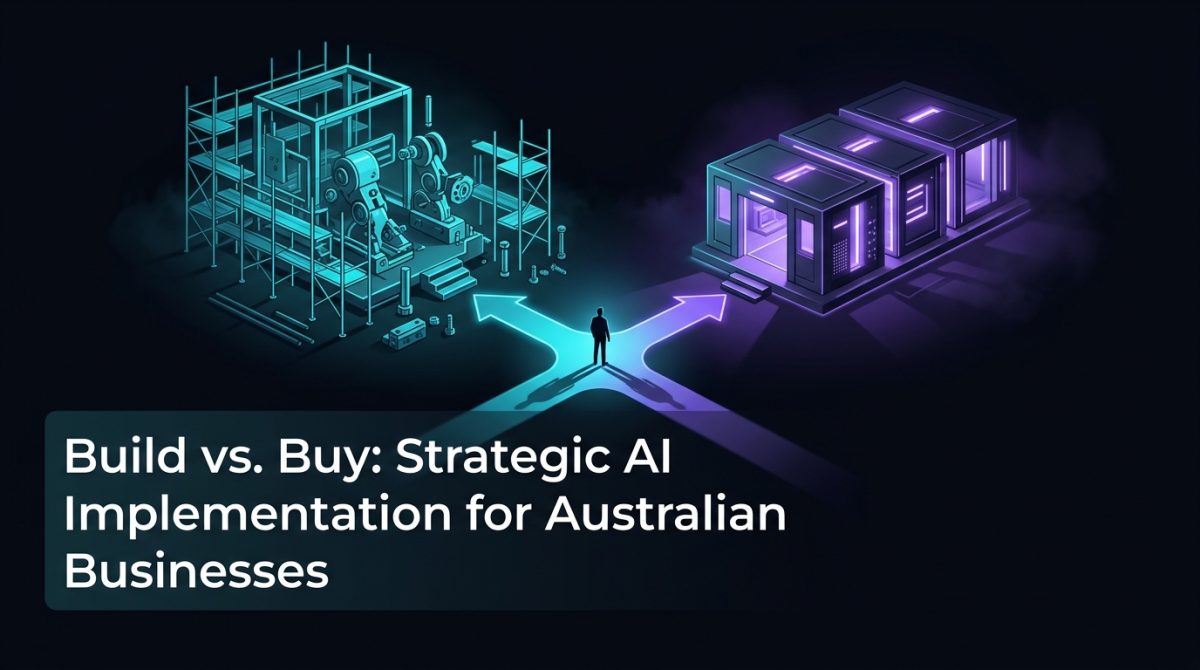
The build vs. buy decision in AI refers to the choice between developing custom AI systems on your own infrastructure, purchasing managed AI services from vendors like Microsoft, Google, or OpenAI, or deploying open-source AI models that you host and maintain internally.
These aren't binary options. Most mature AI implementations sit somewhere on a spectrum:
- Fully managed SaaS AI - you pay per API call or per seat, the vendor handles everything, your data leaves your premises
- Fine-tuned open-source models - you take a foundation model (Llama 3, Mistral, Phi-3) and adapt it to your domain, hosted on your own cloud or on-premises hardware
- Custom-built pipelines - bespoke AI workflow automation built around your specific data, processes, and compliance requirements
- Hybrid architectures - commodity AI tasks routed to managed APIs, sensitive workloads handled by local LLMs on private infrastructure
The right mix depends on three variables: your data sensitivity requirements, your expected usage volume, and how differentiated your AI capability needs to be from your competitors.
When Buying Managed AI Services Makes Sense
Buying managed AI services is the right choice when speed to value matters more than cost optimisation, your data classification allows external processing, and your use case is generic enough that a commodity model performs adequately.
Concrete indicators that buying is appropriate:
- You're processing publicly available or non-sensitive data
- Your use case - summarisation, classification, draft generation - is well-served by GPT-4o or Claude without customisation
- You need to validate an AI concept before committing capital to infrastructure
- Your team lacks the ML engineering capacity to manage model deployment
The cost reality: Azure OpenAI GPT-4o currently prices at approximately USD $5 per million input tokens and $15 per million output tokens. For a business processing 10 million tokens per month - roughly 7.5 million words - that's $150-$200 AUD per month at current exchange rates. That's genuinely cheap for low-to-moderate volume.
The economics shift significantly above roughly 50 million tokens per month, or when you factor in the data egress costs, Azure/AWS markup on API calls, and the compliance overhead of managing a third-party data processor under Australian Privacy Act obligations.
When Building or Self-Hosting Delivers Better ROI
Self-hosting open-source AI models delivers better ROI than managed APIs when monthly token volumes exceed approximately 100 million, when data privacy requirements prohibit external processing, or when your use case requires domain-specific accuracy that general-purpose models don't achieve.
This is where local LLMs and AI-native cloud architectures become commercially relevant, not just technically interesting.
Consider this scenario: a Queensland legal firm processing contract review across 200 matters per month. Each contract review involves approximately 50,000 tokens of input and output. That's 10 million tokens monthly - manageable on managed APIs. But the firm's professional obligations under the Legal Profession Act and their PI insurance requirements mean client documents cannot be processed by a US-based AI provider without explicit client consent and a data processing agreement. The compliance overhead alone justifies self-hosting.
Running Llama 3.1 70B on a single A100 GPU instance (available via Australian AWS regions in Sydney) costs approximately $3.50 AUD per hour. At 8 hours of daily processing, that's roughly $840 AUD per month - with zero per-token costs, full data sovereignty, and the ability to fine-tune the model on the firm's own precedent library.
Open-source AI models worth evaluating for Australian business deployment:
- Llama 3.1 (8B, 70B, 405B) - Meta's flagship, strong general performance, commercially licensable
- Mistral 7B / Mixtral 8x7B - efficient, strong reasoning, lower hardware requirements
- Phi-3 Mini - Microsoft's small model, runs on CPU, suitable for edge deployment
- Qwen2 - strong multilingual and code performance, relevant for diverse Australian workforces
A Practical Framework for Making the Decision
The build vs. buy decision follows a structured evaluation process. Work through these steps before committing to any implementation path.
Step 1: Classify your data Identify which data the AI system will touch. Apply your organisation's data classification scheme. Any data classified as sensitive, confidential, or subject to regulatory controls (health records under My Health Records Act, financial data under ASIC guidance, legal professional privilege) requires a self-hosted or private cloud solution.
Step 2: Estimate your monthly token volume Calculate the expected input and output tokens per transaction, multiply by expected monthly transaction volume. Use this figure to model costs against both managed API pricing and self-hosted infrastructure costs. The crossover point where self-hosting becomes cheaper is typically 80-120 million tokens per month for most use cases.
Step 3: Assess your differentiation requirement If your AI application needs to reflect proprietary knowledge, internal terminology, or domain-specific reasoning that general models don't provide, you need either fine-tuning or retrieval-augmented generation (RAG) on a self-hosted model. Managed APIs support RAG, but fine-tuning on sensitive proprietary data reintroduces the data sovereignty problem.
Step 4: Evaluate your operational capacity Self-hosted models require ML infrastructure management - model updates, GPU instance monitoring, inference optimisation, security patching. If your team doesn't have this capacity, factor in the cost of managed services from an AI implementation services Australia provider before concluding that self-hosting is cheaper.
Step 5: Model the three-year total cost Include infrastructure, licensing, internal engineering time, vendor management overhead, and compliance costs. Most organisations that do this analysis find the three-year TCO of self-hosted solutions is 30-60% lower than managed APIs at scale, but 20-40% higher at low volumes.
Step 6: Define your exit criteria Decide in advance what would trigger a switch from your chosen approach. Vendor price increases above 20%? Data breach at your API provider? Usage volume crossing a threshold? Documenting exit criteria before you start prevents lock-in by default.
The Cost-Effective AI Architecture Most Businesses Miss
The most cost-effective AI architecture for most Australian businesses is a tiered hybrid model: commodity tasks routed to managed APIs, sensitive or high-volume workloads handled by self-hosted models, with a unified API gateway managing routing logic.
This approach uses tools like LiteLLM or a custom FastAPI proxy to present a single internal API endpoint. Your applications call one endpoint; the routing layer decides whether to send the request to OpenAI, your local Llama instance, or a fine-tuned domain model based on rules you define:
# Simplified routing logic example
def route_request(request):
    if request.data_classification == "sensitive":
        return local_llm_endpoint
    elif request.token_count > 10000:
        return cost_optimised_endpoint  # e.g., Haiku or Mistral
    else:
        return managed_api_endpoint  # e.g., GPT-4o for quality-critical tasks
This architecture gives you data privacy controls at the routing layer, cost optimisation by model, and the flexibility to swap underlying models without changing application code. It's the architecture we see delivering the best results for mid-market Australian businesses that have moved past initial AI pilots into production deployment.
What to Do Next
If you're evaluating AI implementation for your business, the most productive first step is a structured assessment of your current data landscape, usage projections, and compliance obligations - before you evaluate any specific tools or vendors.
Organisations that skip this step typically end up rebuilding their AI architecture within 18 months as usage scales or compliance requirements become clearer.
If you want a concrete starting point, use our AI ROI calculator to model the cost difference between managed and self-hosted approaches for your specific volume and use case. It takes about 10 minutes and gives you defensible numbers to take into a board or leadership conversation.
For businesses that need a structured path from assessment through to production deployment, our AI strategy and governance consulting engagements are designed specifically to answer the build vs. buy question with your actual data, your actual compliance context, and your actual operational constraints - not generic frameworks.
The build vs. buy decision is worth getting right. It shapes your AI budget, your data risk profile, and your competitive positioning for the next three years.
Frequently Asked Questions
Q: What is the difference between build vs. buy in AI implementation?
Build vs. buy in AI refers to the choice between developing and hosting custom AI systems internally, purchasing managed AI services from cloud vendors, or deploying open-source models on private infrastructure. The decision affects cost structure, data sovereignty, and how much control you retain over model behaviour and updates.
Q: When should Australian businesses consider self-hosting AI models instead of using managed APIs?
Australian businesses should consider self-hosting AI models when data privacy obligations prevent external processing, when monthly token volumes exceed approximately 100 million tokens, or when the use case requires domain-specific accuracy that general-purpose managed models don't provide. Self-hosting typically becomes cost-competitive at scale and is often mandatory for regulated industries.
Q: How does data privacy affect AI implementation choices in Australia?
Data privacy obligations under the Australian Privacy Act 1988, sector-specific regulations like the My Health Records Act, and professional obligations in legal and financial services frequently prohibit or complicate the use of US-based managed AI APIs for sensitive data. Self-hosted or Australian-region private cloud deployments address these requirements by keeping data within defined jurisdictional boundaries.
Q: What open-source AI models are suitable for Australian business deployment?
Llama 3.1, Mistral 7B, Mixtral 8x7B, and Phi-3 are the most practically deployable open-source models for Australian businesses as of 2024. Each is commercially licensable, actively maintained, and supported by Australian AWS and Azure region infrastructure. Model selection depends on task requirements, hardware budget, and whether fine-tuning on proprietary data is needed.