The Problem Most Australian Enterprises Don't See Coming
Most Australian enterprises are making a costly mistake: they're deploying AI on infrastructure that was never designed to support it. The result is models that run slowly, cost more than expected, and fail to deliver the business outcomes that justified the investment in the first place. If your organisation is serious about AI, the infrastructure conversation has to happen before the deployment conversation - and that's exactly where AI strategy consulting in Australia is delivering its clearest return on investment right now.
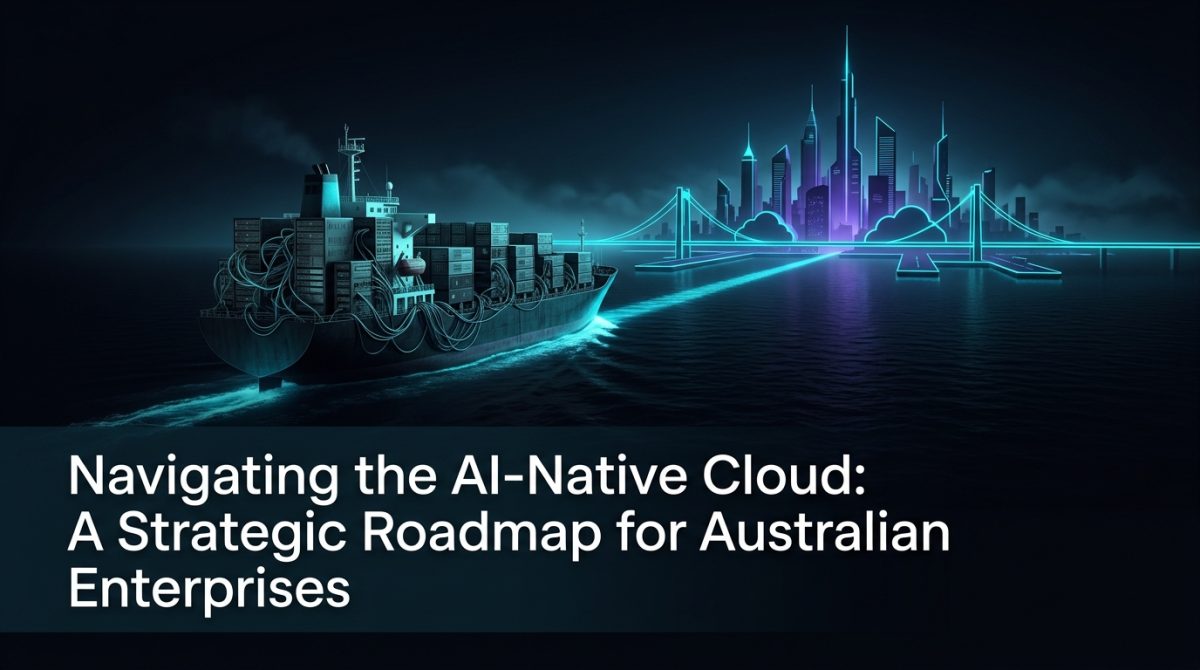
The shift to what practitioners call the "AI-native cloud" isn't a rebrand of existing cloud transformation. It's a fundamentally different architecture: one where compute, storage, networking, and orchestration are designed from the ground up to support inference workloads, model training pipelines, and real-time data processing at scale. Getting this wrong in 2024 doesn't just slow you down - it locks you into technical debt that compounds with every new model you deploy.
What "AI-Native Infrastructure" Actually Means
AI-native infrastructure refers to a cloud architecture where every layer - compute, data pipelines, networking, and orchestration - is purpose-built to support machine learning workloads rather than retrofitted from general-purpose cloud deployments.
This is distinct from simply running a Python script on an EC2 instance or calling the OpenAI API from your existing application server. AI-native infrastructure involves:
- GPU/TPU compute tiers provisioned on demand for training and fine-tuning, separate from CPU-based inference endpoints
- Vector databases (such as Pinecone, Weaviate, or pgvector on PostgreSQL) co-located with retrieval pipelines to reduce latency
- Feature stores that centralise and version the data representations your models depend on
- Model registries integrated with CI/CD pipelines so that model updates follow the same governance controls as application code
- Observability tooling that monitors model drift, token costs, and inference latency in production
Without these components in place, organisations typically see inference costs 3-5x higher than necessary, model performance that degrades silently over time, and deployment cycles that take weeks instead of hours.
Why the Cloud Transformation Conversation Has Changed
Cloud transformation used to mean moving workloads off on-premises servers and onto AWS, Azure, or GCP. That work is largely done for most Australian enterprises. The new transformation challenge is reshaping those cloud environments to handle the specific demands of AI deployment at scale.
Three factors are driving this shift right now:
1. Token economics are real costs. Every call to a large language model (LLM) costs money per token. An enterprise running unoptimised prompts across thousands of daily transactions can accumulate $40,000-$80,000 in monthly API costs that could be reduced by 60% or more through prompt compression, caching, and routing smaller queries to cheaper models.
2. Data sovereignty requirements are tightening. Australian organisations operating under the Privacy Act 1988 and sector-specific regulations (APRA CPS 234 for financial services, My Health Records Act for healthcare) cannot simply route sensitive data through offshore inference endpoints. AI-native infrastructure must account for data residency from the design stage.
3. Latency matters more than most teams expect. A customer-facing AI feature with 4-second response times will be abandoned. Production AI systems require inference latency under 500ms for most interactive use cases - and achieving that requires careful co-location of models, caches, and data sources.
Building Your AI Deployment Strategy: A Practical Framework
A sound AI deployment strategy follows five steps, executed in sequence rather than in parallel.
Step 1: Audit your existing data infrastructure. Before selecting models or platforms, map where your business-critical data lives, how it's governed, and what its latency profile looks like. AI models are only as useful as the data they can access in real time.
Step 2: Define your inference requirements. Separate your use cases into three categories: batch processing (can tolerate minutes of latency), near-real-time (requires seconds), and interactive (requires sub-500ms). Each category has different infrastructure requirements and cost profiles.
Step 3: Choose your model deployment pattern. The three primary patterns are: API-based (calling hosted models like GPT-4o or Claude via API), self-hosted open-source (running Llama 3, Mistral, or similar on your own GPU instances), and hybrid (routing queries dynamically based on sensitivity and complexity). Most Australian enterprises end up with a hybrid pattern for cost and compliance reasons.
Step 4: Instrument before you scale. Deploy observability from day one. Track token usage, model latency, error rates, and output quality metrics. Organisations that skip this step consistently overspend and underperform.
Step 5: Establish a governance layer. Define who can deploy models, what testing is required before production release, and how model behaviour is audited over time. This is where formal AI strategy consulting in Australia adds significant value - governance frameworks that work in practice, not just on paper.
A Concrete Example: Retail Logistics in Queensland
Consider a mid-sized Queensland logistics operator running 200+ delivery routes daily. Their initial AI deployment - a demand forecasting model and a customer communications chatbot - was built on their existing AWS environment with no infrastructure changes. Within three months, they were spending $22,000 per month on API calls, their chatbot had a 6-second average response time, and the forecasting model was producing outputs based on stale data because their ETL pipeline ran only once per day.
After an infrastructure review, three changes were made:
- The chatbot was moved to a self-hosted Mistral 7B instance on a reserved GPU node, reducing per-query costs by 78% and response time to under 800ms.
- A Redis caching layer was introduced for common query patterns, reducing LLM calls by 35%.
- The forecasting pipeline was rebuilt as a streaming job using Apache Kafka, cutting data latency from 24 hours to under 15 minutes.
Total monthly AI infrastructure cost dropped from $22,000 to under $6,000. Forecast accuracy improved by 18% due to fresher data. The chatbot's customer satisfaction score increased from 3.1 to 4.4 out of 5.
This is the kind of outcome that structured AI strategy consulting in Australia consistently delivers - not through novel technology, but through disciplined infrastructure design.
Estimating the Real Cost Savings from AI
Cost savings from AI are real, but they're frequently miscalculated in feasibility assessments. The most common error is measuring only the direct output (time saved on a specific task) without accounting for infrastructure costs, integration overhead, and ongoing maintenance.
A more accurate model looks like this:
Net AI ROI = (Labour cost reduction + Revenue uplift + Error cost reduction)
           - (Infrastructure costs + Integration costs + Maintenance costs + Governance overhead)
For Australian enterprises, realistic cost savings from AI in operational workflows range from 15% to 45% of the targeted process cost, depending on automation depth and data quality. Organisations with clean, well-governed data at the higher end; organisations with fragmented legacy data at the lower end.
If you want to model this for your specific context before committing to an infrastructure investment, our AI ROI calculator gives you a structured starting point.
What to Do Next
If your organisation is evaluating or already running AI workloads, take these three actions before your next planning cycle:
-
Audit your current AI infrastructure costs. Pull your cloud billing data for the last 90 days and isolate every line item related to AI services - API calls, GPU compute, data transfer, and storage. Most teams find 20-40% of spend is on inefficiencies that can be eliminated without touching the models themselves.
-
Map your data residency exposure. Identify which AI use cases involve personal information or regulated data, and confirm whether your current deployment routes that data through compliant endpoints. This is non-negotiable under Australian privacy law.
-
Engage structured AI strategy consulting in Australia. Ad hoc AI deployments accumulate technical and compliance debt quickly. A structured engagement - covering infrastructure design, model selection, governance, and cost optimisation - typically pays for itself within the first quarter of deployment.
Exponential Tech works with Australian enterprises to design and implement AI-native infrastructure that delivers measurable outcomes. If you're ready to move from experimentation to production-grade AI, start with our AI strategy and governance service.
Frequently Asked Questions
Q: What is AI-native infrastructure?
AI-native infrastructure refers to a cloud architecture designed specifically to support machine learning workloads, including purpose-built compute tiers, vector databases, model registries, and observability tooling. It differs from general-purpose cloud infrastructure in that every layer is optimised for the latency, throughput, and governance requirements of AI systems in production.
Q: How much can Australian enterprises realistically save by optimising their AI infrastructure?
Organisations with unoptimised AI deployments typically reduce infrastructure costs by 40-70% through a combination of model routing, prompt caching, self-hosted open-source models, and eliminating redundant API calls. The exact figure depends on current spend patterns and data quality, but the savings in most cases exceed the cost of the infrastructure review within 60-90 days.
Q: What does AI strategy consulting in Australia typically involve?
AI strategy consulting in Australia covers four core areas: infrastructure design, model selection and deployment patterns, data governance and compliance, and ROI measurement frameworks. Engagements typically run 6-12 weeks and produce a prioritised roadmap with defined technical specifications, not just high-level recommendations.
Q: How do Australian privacy laws affect AI deployment decisions?
The Privacy Act 1988 and sector-specific regulations such as APRA CPS 234 impose requirements on how personal and sensitive data is stored, processed, and transferred. AI deployments that route regulated data through offshore API endpoints without appropriate controls expose organisations to regulatory risk. Compliant AI deployment requires data residency planning, contractual protections with model providers, and audit logging of data access at the infrastructure level.