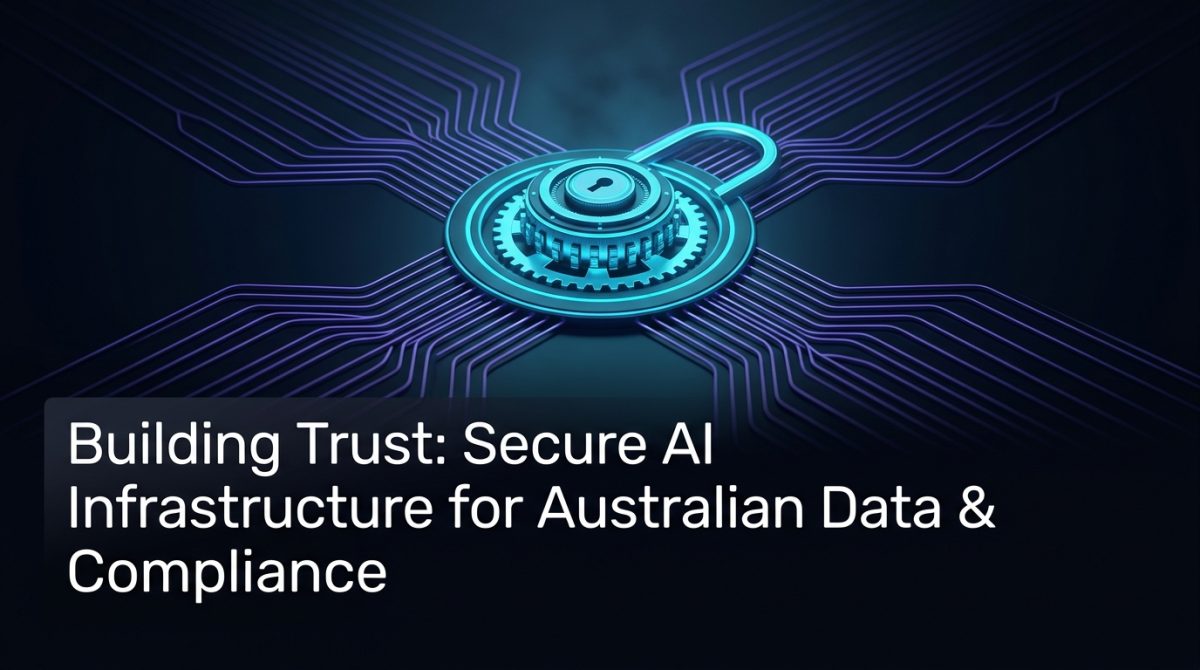
The Real Cost of Getting AI Infrastructure Wrong
Most Australian organisations focus on what AI can do. Few focus on what happens when the infrastructure running that AI fails to meet the country's legal and security obligations. The consequences are not abstract. Under the Privacy Act 1988 and the Australian Privacy Principles (APPs), a notifiable data breach involving AI-processed personal information carries penalties up to $50 million for serious or repeated breaches. For organisations handling government data, the stakes are higher still - the Australian Government Information Security Manual (ISM) sets baseline controls that, if unmet, can result in loss of contracts and mandatory incident reporting to the Australian Cyber Security Centre (ACSC).
Secure AI infrastructure is not a compliance checkbox. It is the technical and operational foundation that determines whether your AI deployment creates value or liability. This article covers the specific design decisions that separate robust AI deployments from fragile ones.
What Secure AI Infrastructure Actually Means
Secure AI infrastructure refers to the complete stack of compute, networking, storage, access controls, and operational processes that host, run, and monitor AI workloads in a way that protects data confidentiality, maintains system integrity, and satisfies applicable regulatory requirements.
This definition matters because "secure" is often applied only to the application layer - the model itself or the API endpoint. In practice, vulnerabilities accumulate across the entire stack: training data pipelines, model weights storage, inference endpoints, logging systems, and the human processes that govern all of them. A model served over a hardened API endpoint is still compromised if the training data pipeline pulls from an unsegmented network or if model outputs are logged to a bucket with public read permissions.
For Australian organisations, this stack must also account for data sovereignty - the requirement that certain data remains within Australian jurisdiction. This is not optional for Commonwealth entities handling PROTECTED or above classified data, and it is increasingly a contractual requirement for state government and critical infrastructure operators.
Choosing the Right Australian Data Centre Configuration
Australian data centres that meet government and enterprise requirements are not interchangeable. The right choice depends on your data classification, latency requirements, and the specific compliance frameworks you operate under.
The three primary options are:
- Hyperscaler Australian regions - AWS Asia Pacific (Sydney), Microsoft Azure Australia East/Southeast, and Google Cloud Sydney all hold IRAP (Information Security Registered Assessors Program) assessments at PROTECTED level. These are appropriate for most commercial and government workloads up to PROTECTED classification.
- Sovereign cloud providers - Providers such as Vault Cloud and Macquarie Government operate infrastructure specifically designed for Australian government data, including air-gapped environments for sensitive workloads.
- On-premises or co-location - For organisations handling classified data above PROTECTED, or where latency to inference endpoints must remain under 10ms, dedicated hardware in a Tier III or Tier IV facility remains the most defensible option.
A practical rule: if your AI workload processes data classified at PROTECTED or above under the Protective Security Policy Framework (PSPF), your infrastructure must be IRAP-assessed at the matching classification level. Running a PROTECTED workload on infrastructure assessed only to OFFICIAL is a compliance gap, regardless of what the vendor's marketing materials say.
How to Build a Secure AI Deployment: A Step-by-Step Approach
Building secure AI infrastructure follows a consistent sequence regardless of organisation size. Skipping steps creates compounding risk.
-
Classify your data before you touch infrastructure. Identify every data source your AI system will ingest, process, or output. Assign a classification under the PSPF or your organisation's equivalent framework. This classification drives every subsequent decision.
-
Define your threat model. Document who might try to access your AI system, what they would want, and how they might try to get it. For most commercial deployments, the primary threats are credential compromise, supply chain attacks on model dependencies, and data exfiltration via inference outputs.
-
Select infrastructure that matches your classification. Use the data classification from step 1 to select an appropriate hosting environment (see section above). Do not select infrastructure first and retrofit classification later.
-
Implement network segmentation. AI workloads - particularly training jobs - require significant data movement. Segment training, inference, and logging environments into separate network zones. Use private endpoints for all cloud service connections. Block all public internet egress from training environments by default.
-
Apply least-privilege access controls. Every service account, human user, and automated process should have access only to what it needs for its specific function. In practice, this means separate IAM roles for data ingestion, model training, model serving, and monitoring - with no role having write access to more than one zone.
-
Enable immutable audit logging. All access to training data, model weights, and inference endpoints must be logged to a write-once store. AWS CloudTrail with S3 Object Lock, Azure Monitor with immutable storage, or an equivalent configuration satisfies this requirement. Logs must be retained for a minimum of 7 years for organisations subject to the Archives Act 1983.
-
Run continuous compliance checks. Deploy infrastructure-as-code scanning tools (Checkov, tfsec, or AWS Config Rules) against your AI infrastructure definitions. Set policies to fail deployments that introduce misconfigured storage buckets, open security groups, or disabled encryption.
Managing Risk When AI Processes Personal Information
AI compliance under Australian law is primarily governed by the Privacy Act 1988, with the Office of the Australian Information Commissioner (OAIC) holding enforcement powers. The key risk areas for AI systems processing personal information are collection limitation, use limitation, and automated decision-making transparency.
Collection limitation means your AI system must not ingest more personal data than is necessary for its stated purpose. In infrastructure terms, this requires data minimisation at the pipeline level - stripping or pseudonymising personal identifiers before data enters training or fine-tuning jobs. A financial services firm running a fraud detection model, for example, does not need full account holder names in its training dataset. Replacing names with consistent pseudonyms before the data enters the training pipeline reduces exposure without degrading model performance.
Use limitation means data collected for one purpose cannot be repurposed for AI training without explicit consent or a lawful basis. This is a common failure point: organisations collect customer interaction data for support purposes, then feed it into an AI training pipeline without reviewing whether the original consent covers that use.
Automated decision-making transparency is becoming a harder requirement. The proposed Privacy Act reforms, if enacted, will introduce a right to explanation for decisions made solely by automated means. Infrastructure that cannot produce a record of which model version, which training data, and which inference call produced a given decision will be non-compliant. Model versioning, dataset lineage tracking, and inference logging are infrastructure requirements, not optional features.
A Practical Scenario: Government Agency AI Deployment
Consider a state government agency deploying a document classification AI to process incoming correspondence, some of which contains personal health information. The data is classified at SENSITIVE under the agency's framework.
The agency selects an IRAP-assessed Azure Australia East environment. The deployment architecture separates the document ingestion pipeline, the inference endpoint, and the output storage into three distinct resource groups with no cross-group network access. All data in transit uses TLS 1.3; all data at rest uses AES-256 encryption with keys managed in Azure Key Vault with BYOK (Bring Your Own Key).
Human reviewers access inference outputs through a private endpoint only accessible via the agency's managed desktop environment. No inference output is accessible from the public internet. Audit logs flow to an immutable Log Analytics workspace retained for 7 years.
The result: the agency passes its internal security assessment in the first review cycle, with zero findings related to data handling. The same deployment without the network segmentation and immutable logging would have generated at least four ISM control gaps.
What to Do Next
If you are planning or reviewing an AI deployment, take these three actions before committing to infrastructure:
- Audit your data classification. If you cannot answer "what is the highest classification of data this AI system will touch?", you are not ready to select infrastructure.
- Check your vendor's IRAP status. Ask for the current IRAP assessment letter, not just a claim of compliance. Assessments expire and scope varies.
- Map your logging architecture. Confirm that model versioning, dataset lineage, and inference logs are captured in an immutable, auditable store before you go to production.
Exponential Tech works with Australian organisations to design and implement secure AI infrastructure that meets ISM, PSPF, and Privacy Act requirements. If you need a technical review of your current or planned AI deployment, contact us at exponentialtech.ai.
Frequently Asked Questions
Q: What is secure AI infrastructure?
Secure AI infrastructure refers to the complete technical and operational stack - compute, storage, networking, access controls, and monitoring - that hosts AI workloads in a way that protects data confidentiality, maintains integrity, and satisfies applicable regulatory and compliance requirements. It covers the entire system from data ingestion pipelines through to inference endpoints and audit logging, not just the model or application layer.
Q: Do Australian organisations need to use Australian data centres for AI workloads?
Commonwealth entities handling PROTECTED or above classified data must use IRAP-assessed infrastructure at the matching classification level, which in practice means Australian-region cloud or on-premises deployments. Commercial organisations are not legally required to use Australian data centres, but the Privacy Act 1988 requires that overseas data transfers are protected by equivalent privacy safeguards, and many contracts with government clients impose data residency requirements explicitly.
Q: What are the penalties for AI-related data breaches in Australia?
Under the Privacy Act 1988 as amended by the Privacy Legislation Amendment (Enforcement and Other Measures) Act 2022, serious or repeated privacy breaches carry penalties of up to $50 million, or three times the benefit obtained from the breach, or 30% of the organisation's adjusted turnover during the breach period - whichever is greater. These penalties apply to AI systems that process personal information without adequate safeguards.
Q: How does risk management apply to AI deployments?
Risk management for AI deployments involves identifying threats to data confidentiality, model integrity, and system availability; assessing the likelihood and impact of each threat; and implementing controls proportionate to the risk. In practice, this means conducting a threat model before infrastructure selection, applying the Australian Government's ISM controls as a baseline, and running continuous compliance checks against infrastructure-as-code definitions throughout the deployment lifecycle.