Most Business Processes Were Not Designed for AI - And It Shows
The average mid-sized Australian business runs on a stack of disconnected systems: an ERP that exports to spreadsheets, a CRM that doesn't talk to the finance platform, and document workflows that still rely on someone manually copying data between tabs. These processes were designed around human limitations - the need to read, interpret, and re-enter information at every handoff point.
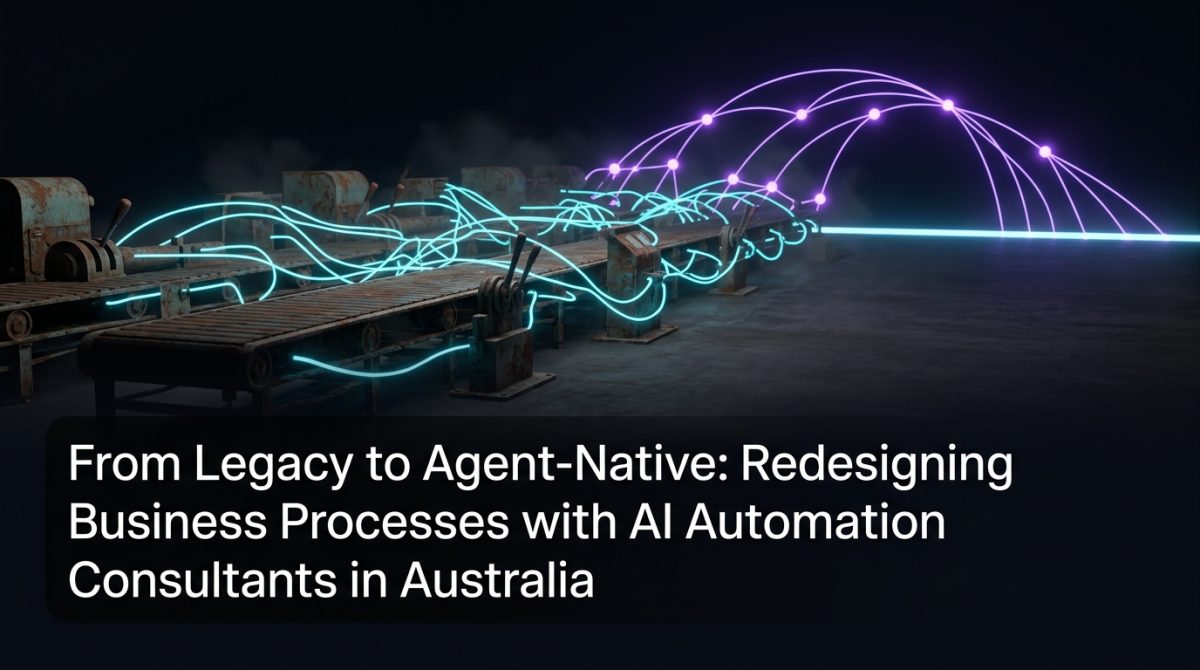
When organisations bolt AI tools onto these legacy workflows, they get marginal gains at best. A chatbot on the front end of a broken process is still a broken process. Real transformation happens when you redesign the workflow itself around what AI can actually do: process unstructured data at scale, make decisions against defined rule sets, trigger actions across systems without human intervention, and learn from feedback loops over time.
This is the shift from legacy automation to business process automation AI - and it requires a fundamentally different approach to how you map, redesign, and implement your operations.
What "Agent-Native" Actually Means in Practice
An agent-native business process is one designed from the ground up to be executed, monitored, and improved by AI agents rather than adapted from a human-centric workflow. This is distinct from traditional robotic process automation (RPA), which mimics human actions in existing interfaces without changing the underlying logic.
In an agent-native workflow, the process architecture itself changes:
- Data inputs are structured at the point of capture, not reformatted downstream
- Decision nodes are explicit and rule-based, with escalation paths for edge cases
- System interactions happen via APIs rather than screen scraping or manual entry
- Audit trails are generated automatically at every step
A practical example: a logistics company processing freight invoices manually - matching purchase orders, checking line items, flagging discrepancies, and approving payment - might take a team of three people two to three days per week. An agent-native redesign of that same process uses an AI pipeline that ingests invoice PDFs via OCR, maps line items against the ERP via API, applies matching logic, flags exceptions to a human reviewer queue, and posts approved invoices directly to the accounts payable system. End-to-end processing time drops from days to under four hours, with human involvement limited to genuine exceptions.
This is not a technology swap. It is a process redesign that happens to be enabled by technology.
How to Build an AI strategy Roadmap for Process Redesign
Building an effective AI strategy roadmap for process transformation follows a structured sequence. Skipping steps - particularly the discovery and mapping phases - is the most common reason AI automation projects fail to deliver measurable ROI.
Step 1: Process audit and prioritisation Document every process that involves data movement, decision-making, or repetitive task execution. Score each against two axes: volume/frequency and complexity of decision logic. High-volume, lower-complexity processes are your first targets.
Step 2: Data readiness assessment AI agents require clean, accessible data. Assess whether your source systems expose data via APIs, whether historical data is structured and labelled, and whether you have the governance frameworks to manage data quality at scale. Many organisations discover at this stage that data remediation is a prerequisite to automation.
Step 3: Workflow decomposition Break each target process into discrete steps. Identify which steps require human judgement, which are rule-based, and which involve retrieving or synthesising information. This decomposition determines what type of AI component - LLM, classifier, retrieval system, or rules engine - belongs at each node.
Step 4: Integration architecture design Map how your AI components will connect to existing systems. This typically involves API gateway configuration, webhook design, and decisions about whether to use middleware platforms (such as n8n, Make, or custom-built orchestration layers) to manage workflow state.
Step 5: Pilot build and baseline measurement Build the redesigned workflow for one process end-to-end. Measure against a pre-defined baseline: processing time, error rate, cost per transaction, and staff hours consumed. Pilots that don't establish a baseline before deployment cannot demonstrate ROI.
Step 6: Iteration and scaling Use the pilot data to refine decision logic, adjust escalation thresholds, and identify gaps in data quality. Once the pilot process runs reliably at target performance levels, apply the same methodology to the next prioritised process.
This structured approach to AI strategy roadmap development is what separates projects that deliver measurable outcomes from those that generate activity without results. Our AI strategy and governance services are built around exactly this methodology.
Where Intelligent Workflows Break Down (And How to Fix Them)
Intelligent workflows break down at three predictable points: data quality failures, integration brittleness, and inadequate exception handling.
Data quality failures occur when source systems contain inconsistent formats, missing fields, or duplicate records. An AI agent trained to extract supplier names from invoices will fail unpredictably if the same supplier appears under three different names across your ERP and procurement system. The fix is upstream data standardisation - enforcing consistent data entry rules at the source, not cleaning data after the fact.
Integration brittleness happens when automation relies on fragile connections: screen scraping, hardcoded file paths, or API calls without error handling. A single system update can break an entire pipeline. Robust AI systems integration uses versioned APIs, retry logic, dead-letter queues for failed messages, and monitoring alerts that trigger before failures cascade.
Inadequate exception handling is the most common failure mode in early AI automation deployments. When an agent encounters a scenario outside its training distribution, it needs a defined path: log the exception, route it to a human reviewer, and record the resolution for future model improvement. Workflows that don't have this path either fail silently or require manual intervention at a rate that negates the automation benefit.
The operational reality is that no AI system handles 100% of cases autonomously from day one. A well-designed workflow targets 80-85% straight-through processing in the first quarter, with that figure improving to 92-95% over six months as edge cases are captured and addressed.
The Role of knowledge systems in Process Automation
Many business processes require agents to retrieve and apply institutional knowledge - policy documents, product specifications, compliance requirements, or historical precedents. This is where retrieval-augmented generation (RAG) becomes a critical component of the automation stack.
RAG refers to an architecture in which an AI model retrieves relevant documents or data from a structured knowledge base before generating a response or making a decision. Rather than relying on what the model learned during training, it pulls current, organisation-specific information at inference time.
In a practical business process automation AI context, this means an agent handling customer contract queries can retrieve the specific terms of that customer's agreement, apply the relevant policy, and generate a compliant response - without a human needing to look up the document manually. The same architecture supports compliance checking, technical support triage, and procurement approval workflows.
Organisations that invest in well-structured knowledge systems see a measurable reduction in escalation rates - typically 30-45% fewer queries requiring human review - because agents have access to the information they need to resolve queries autonomously. Our RAG knowledge systems implementation service covers the full build: document ingestion pipelines, chunking strategies, vector store configuration, and retrieval quality evaluation.
What Australian Businesses Get Wrong About AI-Native Transformation
AI-native transformation is the process of redesigning an organisation's operations, systems, and workflows so that AI is a structural component of how work gets done - not an add-on to existing processes. Most Australian businesses underestimate the organisational change component and overestimate the technology complexity.
The technology to build sophisticated AI workflows is available and increasingly accessible. The harder work is:
- Getting stakeholder alignment on which processes to automate and in what sequence
- Redefining roles as AI takes over routine task execution and humans focus on exception handling and oversight
- Establishing governance frameworks that define how AI decisions are audited, overridden, and improved
- Building internal capability to maintain and iterate on AI systems after the initial build
Organisations that treat AI transformation as an IT project consistently underdeliver. Organisations that treat it as an operational redesign programme - with executive sponsorship, cross-functional teams, and defined success metrics - consistently outperform.
The businesses seeing the strongest results from business process automation AI in Australia are those that engage experienced AI automation services partners early, not to outsource the thinking, but to accelerate the structured methodology that turns process analysis into working systems.
What to Do Next
If your organisation is running manual or semi-automated processes that involve repetitive data handling, document processing, or multi-system coordination, you are leaving measurable efficiency and cost reduction on the table.
The practical starting point is not a technology decision - it is a process audit. Map your highest-volume workflows, identify where human time is consumed by tasks that follow predictable rules, and assess your data readiness. That analysis will tell you where AI automation delivers the fastest return and what needs to be addressed before deployment.
Exponential Tech works with Australian businesses to move from that initial audit through to production-grade AI systems. If you want a structured assessment of where business process automation AI applies in your operations, explore our services or get in touch directly to discuss your specific context.
Further Reading
Frequently Asked Questions
Q: What is business process automation AI?
Business process automation AI refers to the use of artificial intelligence - including large language models, classification systems, and retrieval-augmented generation - to execute, monitor, and improve business workflows without continuous human intervention. Unlike traditional automation, AI-based systems handle unstructured data, apply contextual decision logic, and adapt to variation in inputs.
Q: How long does it take to implement an AI-native workflow in an Australian business?
A well-scoped pilot for a single process typically takes six to ten weeks from discovery to production deployment. This includes process mapping, data readiness assessment, integration design, build, testing, and baseline measurement. Scaling to additional processes accelerates once the integration architecture and governance frameworks are established.
Q: What processes are best suited to AI automation?
Processes with high transaction volume, repetitive decision logic, structured or semi-structured data inputs, and clear success criteria are the strongest candidates for AI automation. Invoice processing, customer query triage, compliance document review, and data extraction and enrichment workflows consistently deliver strong ROI in the first implementation cycle.
Q: What is the difference between RPA and AI process automation?
Robotic process automation (RPA) mimics human actions within existing interfaces - clicking, copying, and entering data - without changing the underlying process logic. AI process automation redesigns the workflow itself, using AI components to handle unstructured inputs, make contextual decisions, and integrate directly with systems via APIs. RPA is brittle and interface-dependent; AI automation is more robust and scales with data volume rather than headcount.