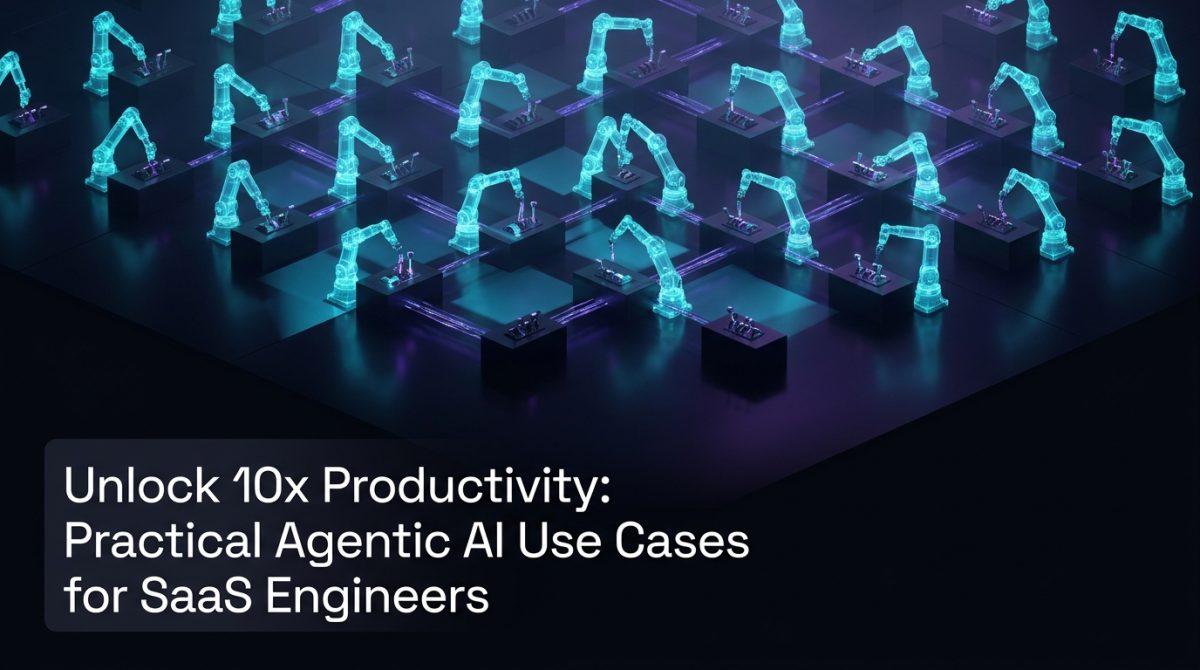
The Productivity Gap Most SaaS Teams Are Ignoring
SaaS engineering teams are shipping slower than they should be. Not because their developers lack skill, but because those developers spend 40-60% of their working week on tasks that don't require human judgement: writing boilerplate, triaging issues, updating documentation, chasing down integration bugs, and reviewing routine pull requests. That's the problem agentic AI productivity solves - not by augmenting individual tasks, but by removing entire categories of low-value work from the human queue entirely.
Agentic AI refers to AI systems that pursue multi-step goals autonomously, making decisions, using tools, and adapting to feedback without requiring a human prompt at each step. Unlike a standard LLM interaction where a developer asks a question and gets an answer, an autonomous agent receives an objective and executes a sequence of actions - calling APIs, reading codebases, writing and running tests, updating tickets - until the goal is achieved or it hits a decision point that requires human input.
For SaaS engineers specifically, this architecture maps directly onto the repetitive, tool-heavy workflows that dominate the development lifecycle. Here's where the gains are real, measurable, and achievable today.
Automated Code Review and PR Triage at Scale
Agentic AI delivers the most immediate ROI in code review by handling the first pass on every pull request - catching issues, enforcing standards, and surfacing context - before a human reviewer opens the diff.
A well-configured autonomous agent connected to your GitHub or GitLab repository can:
- Check for violations of your team's specific coding standards (not just linting rules, but architectural patterns)
- Cross-reference the PR against related issues, previous bugs, and recent changes to the same modules
- Identify missing test coverage against the changed lines
- Draft a structured review comment with severity ratings and suggested fixes
The difference between this and a standard linting tool is that the agent reasons across context. It understands that a change to a shared utility function has downstream implications for three other services, because it has read the dependency graph and the git history.
Teams using this approach report reducing human review time per PR by 35-50%, with reviewers focusing exclusively on architectural decisions and business logic rather than formatting and obvious errors.
Example: A B2B SaaS company with a 12-person engineering team configured an agent using GPT-4o with tool access to GitHub, Jira, and their internal Confluence documentation. The agent now handles first-pass review on every PR under 400 lines, auto-closes issues when linked PRs are merged, and posts a weekly digest of recurring code quality patterns to the engineering Slack channel. The team reclaimed approximately 6 hours per engineer per week.
Autonomous Systems Integration Testing
Agentic AI productivity gains are particularly significant in integration testing, where the combinatorial complexity of API dependencies makes manual coverage impractical. An autonomous agent can generate, execute, and iterate on integration test suites against live staging environments without human intervention between cycles.
Here's how a practical implementation works:
- Define the scope: Point the agent at your OpenAPI specification or GraphQL schema and specify the services under test.
- Generate test cases: The agent produces test scenarios covering happy paths, edge cases, and known failure modes drawn from your issue tracker history.
- Execute against staging: The agent runs tests against your staging environment, captures responses, and logs deviations from expected behaviour.
- Triage failures: For each failure, the agent classifies the root cause (schema mismatch, auth failure, timeout, data dependency), checks recent commits for likely culprits, and creates a structured bug report with reproduction steps.
- Iterate: The agent reruns the affected tests after each relevant commit, updating its failure analysis without being prompted.
This removes the single biggest bottleneck in systems integration work: the cycle time between a failure occurring and a developer understanding what caused it. Autonomous agents compress that cycle from hours to minutes.
Documentation That Stays Current
Outdated documentation is a tax on every engineer who joins a team or picks up an unfamiliar service. Agentic AI eliminates documentation drift by treating docs as a living artefact that updates automatically in response to code changes.
An AI-native documentation agent monitors your repository for changes to public interfaces, configuration schemas, environment variables, and deployment scripts. When a change is detected, the agent:
- Identifies which documentation sections are affected
- Drafts updated content in your team's established style and terminology
- Opens a documentation PR linked to the originating code PR
- Flags sections where the change introduces ambiguity that requires human clarification
The agent doesn't replace technical writers - it ensures that the raw material is always current, so writers focus on structure and clarity rather than chasing engineers for updates.
Teams that implement this pattern report documentation coverage increasing from an industry-average 40% to above 85% within three months, with no additional headcount.
Incident Response and On-Call Automation
Agentic AI reduces mean time to resolution (MTTR) in incident response by automating the investigative work that currently falls on on-call engineers at 2am. An autonomous agent connected to your observability stack - Datadog, Grafana, PagerDuty, or equivalent - acts as a first responder.
When an alert fires, the agent:
- Queries your metrics and logs to establish the scope and timeline of the incident
- Cross-references the alert signature against historical incidents in your runbooks
- Identifies correlated changes in recent deployments or infrastructure modifications
- Posts a structured incident summary to your incident channel with severity assessment, likely cause, and recommended remediation steps
- Escalates to a human on-call engineer with a pre-populated incident ticket
This doesn't eliminate the need for human engineers in incident response. It means that when a human is paged, they arrive at a situation that's already been diagnosed rather than a blank screen of alerts. Teams using this pattern reduce MTTR by 45-60% and cut unnecessary out-of-hours pages by approximately 30%.
Developer tools that support this workflow include LangChain-based agent frameworks, AWS Bedrock Agents, and purpose-built platforms like PagerDuty's AIOps integration layer.
Feature Scaffolding and Boilerplate Generation
Software development velocity is constrained by the time engineers spend on work that is structurally identical across every new feature: creating service files, writing CRUD endpoints, setting up test fixtures, configuring dependency injection, and updating routing. An autonomous agent reduces this to a single prompt.
A practical scaffolding agent accepts a feature specification - either from a Jira ticket or a natural language description - and produces:
/src
  /features
    /user-notifications
      controller.ts
      service.ts
      repository.ts
      dto.ts
      notifications.module.ts
      __tests__/
        notifications.service.spec.ts
        notifications.controller.spec.ts
The generated code follows your existing patterns by learning from your codebase, not from generic templates. The agent reads your current service implementations, extracts the conventions you use for error handling, logging, and validation, and applies them consistently to the new scaffold.
This is where AI-native development workflows create compounding returns. Each scaffold the agent generates is consistent with the last, which makes code review faster, onboarding easier, and refactoring more predictable.
Engineers using scaffolding agents report reducing feature setup time from 3-4 hours to under 20 minutes per feature, with higher consistency than manual implementation.
What to Do Next
Agentic AI productivity improvements don't require a platform overhaul or a six-month implementation project. The most effective approach is to start with one high-frequency, well-defined workflow and instrument it properly before expanding.
Practical starting points for SaaS engineering teams:
- Audit your sprint retrospectives for the past three months and identify the three tasks your team mentions most often as time-consuming and low-value. These are your first automation targets.
- Pick one agent use case from this article that maps to your highest-pain workflow. PR triage is the fastest to implement and the easiest to measure.
- Choose your framework: LangChain, LlamaIndex, and AWS Bedrock Agents are the three most production-ready options for teams without a dedicated AI engineering function.
- Define your success metric before you build. If you can't measure the current state, you can't demonstrate the improvement. Time-to-first-review, MTTR, and documentation coverage are all straightforward to baseline.
- Run a four-week pilot with one team, one workflow, and one clear metric. Expand based on evidence, not enthusiasm.
If you want to move faster or need help identifying where autonomous agents will generate the most value in your specific stack, Exponential Tech works with SaaS engineering teams across Australia to design and implement agentic AI systems that are production-ready from day one. Visit exponentialtech.ai to start the conversation.
Frequently Asked Questions
Q: What is agentic AI productivity and how does it differ from standard AI tools?
Agentic AI productivity refers to the measurable output gains achieved when AI systems autonomously complete multi-step tasks - such as code review, testing, and documentation - without requiring a human prompt at each step. Unlike standard AI tools that respond to individual queries, autonomous agents pursue goals across a sequence of actions, using tools like APIs, codebases, and ticketing systems to complete work end-to-end.
Q: Which agentic AI use cases deliver the fastest ROI for SaaS engineering teams?
Automated PR triage and first-pass code review delivers the fastest measurable ROI, with teams typically reclaiming 35-50% of human review time within the first month of implementation. Incident response automation is the second fastest, reducing MTTR by 45-60% and eliminating a significant proportion of unnecessary out-of-hours escalations.
Q: Do autonomous agents replace software engineers?
Autonomous agents do not replace software engineers - they remove low-value, repetitive tasks from the engineering queue so that engineers focus on work that requires human judgement. The practical effect is that a team of 10 engineers can ship the output previously requiring 14-15, without reducing headcount or increasing working hours.
Q: What infrastructure does a SaaS team need to implement agentic AI workflows?
A SaaS team needs three things to implement agentic AI workflows: access to an LLM with tool-calling capability (such as GPT-4o or Claude 3.5 Sonnet), an agent orchestration framework (LangChain, LlamaIndex, or AWS Bedrock Agents are the most production-ready options), and API access to the tools the agent will use - GitHub, Jira, your observability platform, and your documentation system. Most teams can stand up a working pilot within two to three weeks using existing infrastructure.